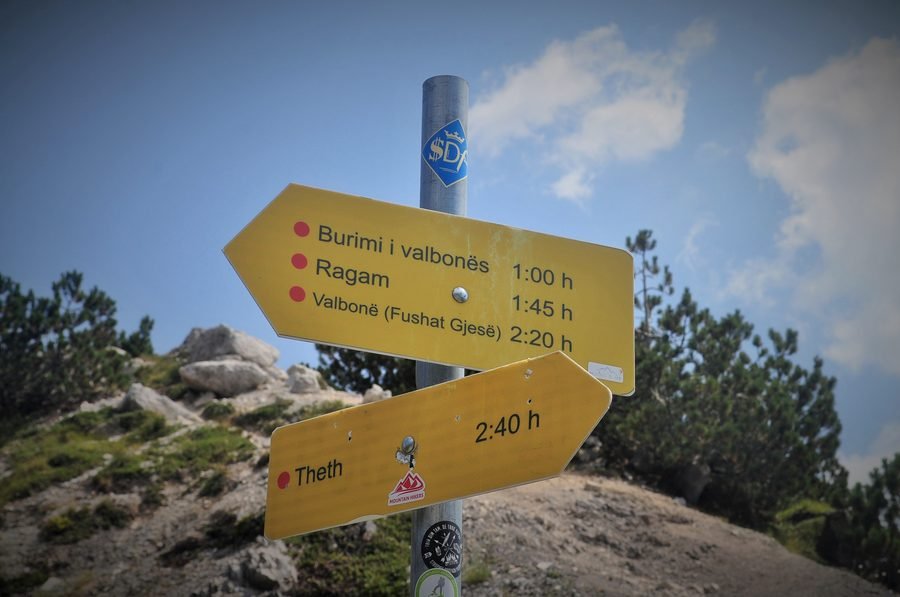
There is a hike in the far north of Albania that most travellers never make. Connecting the glacial valley of Valbona with the isolated village of Theth, it crosses the Bjeshkët e Namuna — the Accursed Mountains — through high alpine terrain that has barely changed in a thousand years. Hikers who complete it consistently rank it among the finest one-day trails in Europe. The views, the remoteness, the physical challenge, the guesthouses at either end serving fresh food and strong raki: the whole package is extraordinary. This guide is your complete briefing.

The route at a glance
The hike runs from Valbona village (approximately 950 metres above sea level) south-east to the Valbona Pass at 1,760 metres, then descends west into Theth village at around 700 metres. Total distance is roughly 18 kilometres. Most hikers allow between five and eight hours depending on fitness, pace, and how long they spend at the pass or on photo stops along the way.
The route is waymarked throughout with red-and-white paint blazes on rocks and trees — the standard alpine trail marker used across the region. You will rarely feel lost on a clear day. That said, mist and cloud roll in quickly in the mountains, and in poor visibility the upper section becomes genuinely confusing. If the weather looks uncertain, hire a local guide or wait a day.
Difficulty is best described as moderate-to-challenging. The first half — the climb from Valbona to the pass — involves around 810 metres of elevation gain over roughly 10 kilometres, with a sustained steep section in the final push to the summit. Most fit hikers find this demanding but not technical. The descent to Theth is gentler and longer but harder on the knees. There are no via ferrata sections, no ropes, and no scrambling required under normal summer conditions.
Trail profile
Best season
The trail is open and at its best from June through September. Snow typically closes the Valbona Pass until late May, and by October the first significant snowfalls can return. July and August are the busiest months on the trail and in the guesthouses at both ends — book accommodation at least a few days ahead in peak season. Early June and September offer quieter conditions and often better light for photography.
Do not underestimate the temperature at the pass even in the height of summer. Conditions at 1,760 metres can be dramatically different from those in the valley below — cold wind, cloud, even sleet are all possible in July. The weather changes fast. Always carry layers regardless of the conditions at your starting point.
Getting to Valbona
The logistics of reaching Valbona are part of the adventure — and they are considerable. The standard route from Tirana takes between eight and ten hours and involves several legs. Allow a full travel day.
From Tirana, take a bus or furgon (shared minivan) north to Shkodër — roughly two hours. From Shkodër, a furgon connects to Bajram Curri; alternatively, from Shkodër's ferry terminal, you can board the Lake Koman ferry. The Lake Koman ferry departs at 09:00 daily and is widely regarded as one of the most beautiful boat journeys in Europe — roughly two and a half hours threading through a narrow, cliff-flanked reservoir of extraordinary depth and colour. From the ferry landing at Fierzë, a connecting furgon covers the final stretch to Valbona in around an hour.
Many travellers split the journey and spend a night in Shkodër, which is worth exploring in its own right (the castle, the old bazaar, the lakeshore). Depart Shkodër by 07:30 to comfortably make the 09:00 ferry departure.
An alternative for those short on time: organised day tours from Tirana that handle the logistics and include a local guide. They cost more but remove the stress of connection timing.

On the trail: what to expect
The hike begins in Valbona village, typically from one of the guesthouses near the river. The first few kilometres follow a broad track through the valley alongside the milky turquoise waters of the Valbona River — this section is flat and easy, an ideal warm-up. As the valley narrows, the path begins to climb through pine and beech forest. The gradient increases steadily.
The steepest climbing begins roughly six to eight kilometres from the start, as the trail leaves the treeline and heads across open alpine meadows and scree towards the pass. This section is exposed and strenuous — take it steadily, eat something, and look back occasionally at the Valbona Valley receding below. The pass itself is a narrow col with extraordinary panoramic views in both directions on a clear day. Most hikers spend fifteen to thirty minutes here.
The descent into Theth is longer and gentler than the ascent, following a series of well-worn switchbacks down through forest into the valley. The first sight of the Theth church spire — built in 1892, one of the most photographed buildings in Albania — emerging through the trees announces your arrival. The guesthouses of Theth are spread along the valley for another kilometre or two from the church.
Theth: what to see
Theth is not simply a destination — it is a destination in its own right. The village sits in a deep, glacially carved valley with a character quite unlike anywhere else in Albania. Stone houses with wooden balconies face the mountains; the sound of the river runs under everything. Allow at least one full rest day here if your schedule permits.
The Blue Eye of Theth (Syri i Kaltër i Thetit) is a short walk from the village — a cold spring of impossibly vivid blue-green water bubbling up from the limestone. It is smaller than the more famous Blue Eye near Sarandë but arguably more dramatic in its mountain setting. The Lock-in Tower (Kulla e Ngujimit) is a centuries-old stone refuge tower where men sought protection during blood feuds — it stands as one of the most haunting physical reminders of the Kanun legal code that governed northern Albanian life for centuries. And the Theth Church of 1892, modest in scale but exceptional in setting, backed by jagged limestone peaks, is one of the most photographed subjects in Albanian photography.
Where to stay
Accommodation at both ends is in family-run guesthouses, and these are one of the great pleasures of this hike. Most offer half-board — a room plus dinner and breakfast — at rates that feel almost incongruously affordable: roughly €15–25 per person per night in Valbona and €15–20 per person per night in Theth. Meals are home-cooked, generous, and often exceptional — fresh salads from the garden, lamb or goat stew, local cheese and honey, raki poured without being asked.
In high season (July–August), the most popular guesthouses fill up. Send a message via WhatsApp a few days in advance — most hosts respond quickly and speak enough English for booking purposes. Lists of guesthouses are available from the Valbona Valley National Park administration and from several hiking-focused travel agencies in Tirana.
Hiring a local guide
A local guide costs approximately €20–30 per day and is highly recommended, particularly for first-time visitors to the Albanian Alps. Beyond the practical benefits — navigational certainty, someone who knows the mountain weather patterns — hiring a guide directly supports the local economy of communities that have very limited alternative sources of income. Most guesthouses can arrange a guide; alternatively, the Valbona community tourism initiative matches hikers with accredited local guides. Your guide will almost certainly become one of the more memorable people you meet on a trip to Albania.
Packing checklist
Practical tips
Start early. Leave Valbona guesthouse no later than 07:00–08:00. This gives you the best chance of clear conditions at the pass (clouds tend to build through the afternoon), avoids the hottest midday sun on the climb, and ensures you arrive in Theth with time to find your guesthouse and explore before dark.
Cell service is minimal. Expect to have no usable mobile signal for the majority of the hike. Download your maps offline before leaving the guesthouse. WhatsApp messages sent the previous evening to your Theth guesthouse will arrive when you re-enter coverage in the valley.
The hike can be done in reverse. Starting from Theth (Theth → Valbona) means the steep section becomes a descent, which some hikers find easier on the cardiovascular system but harder on the knees. The logistics of exiting from Valbona by Lake Koman ferry (09:00 departure daily) mean that the Valbona-start direction generally works better for most itineraries.
Altitude at the pass. Even experienced hikers occasionally feel the effects of altitude at 1,760 metres — minor breathlessness, slight headache. Rest at the pass, drink water, eat something. It passes.
Cash only. Guesthouses in both Valbona and Theth are cash-only. Bring enough Albanian lek (or euros, widely accepted) to cover accommodation, meals, and a guide if hiring one. The nearest ATM is in Bajram Curri.
Ready to hike Valbona to Theth?
Browse verified guided hiking tours and local operators in the Albanian Alps.
Find guided hiking tours →