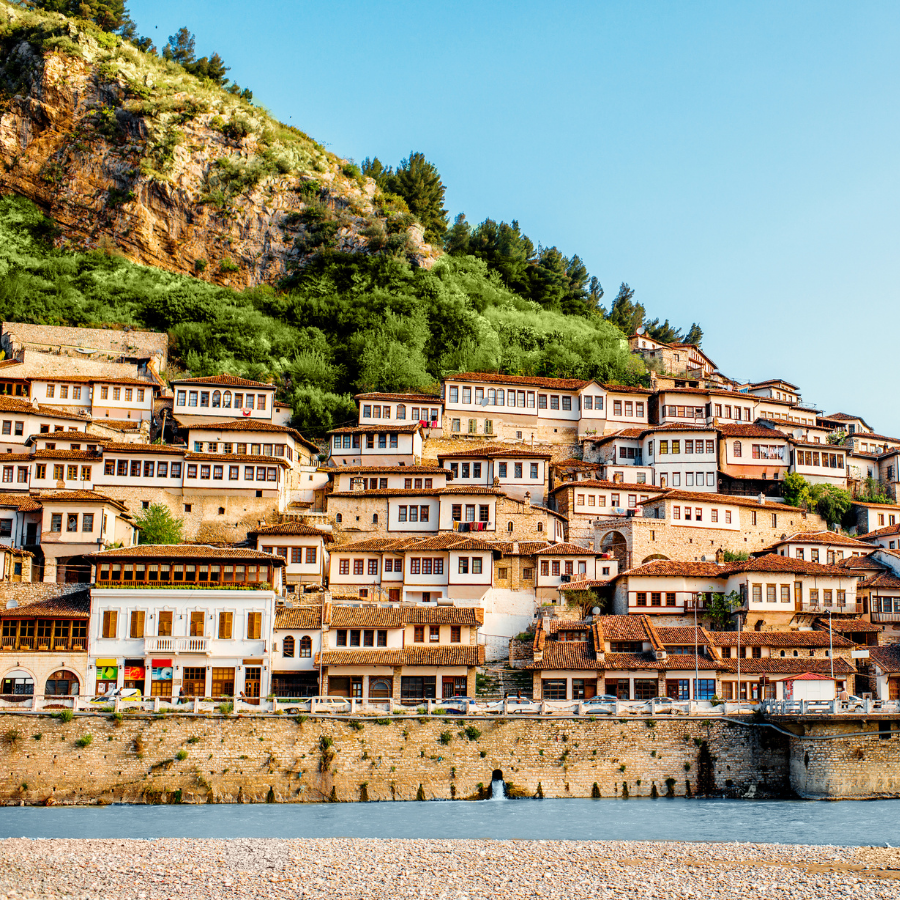
Stand on the Gorica Bridge in Berat at golden hour and look back at the old Mangalem quarter: hundreds of white Ottoman houses stacked up the steep hillside, every one of them facing outward with rows of large windows that glitter in the afternoon light. This is why Berat earned its nickname — Qyteti i Mijë Dritareve, the City of a Thousand Windows — and it is one of the most visually arresting sights in all of Albania.
Berat is not merely photogenic. It is one of the oldest continuously inhabited cities in the Balkans, with a documented history stretching back over 2,500 years. Its castle citadel — still inhabited today — has been home to Illyrians, Romans, Byzantines, Bulgarians, Normans, and Ottomans in succession. The city earned UNESCO World Heritage status in 2005, jointly with Gjirokastër, in recognition of its extraordinary architectural and historical significance.
And yet, despite all this, Berat remains surprisingly unhurried. The cafés along the river fill slowly on weekday afternoons, the cobblestone streets of the upper town are often empty, and it is still quite possible to have the Onufri Museum largely to yourself. This guide will make sure you make the most of it.

Understanding Berat's three distinct quarters
Berat is actually three cities layered on top of each other — or rather, arranged across two hillsides and a riverbank. Understanding this geography before you visit makes everything far easier to navigate:
- Mangalem — the historic Muslim quarter on the steep western hillside, with those iconic white Ottoman houses piled above the riverside promenade. Most restaurants, cafés, and guesthouses are here. This is where you'll spend most of your time.
- Gorica — the historic Christian quarter on the opposite eastern bank of the Osum River, reached via a narrow bridge. Quieter than Mangalem, with its own distinct character and excellent views back across the river to Mangalem.
- Kala — the castle citadel perched on the summit of the rocky hill above Mangalem, reached by a steep climb or a winding road. Still inhabited today — families live inside the medieval walls, tending gardens and keeping chickens amid the Byzantine churches.
Berat in one day — suggested itinerary
Berat Castle (Kalaja e Beratit) — the living citadel
Berat's castle is one of the most remarkable fortified settlements anywhere in Europe. First built during the Hellenistic period and substantially expanded by the Byzantines in the 5th century, the Kala has been continuously inhabited for over 2,500 years — and it remains inhabited today. Families still live within the thick medieval walls, their vegetable gardens and lemon trees growing between Byzantine churches and Ottoman fountains.

Within the castle walls you'll find over 20 Orthodox churches, several mosques, and a wealth of Byzantine architecture spanning nearly 1,500 years. The most important churches are:
- Church of the Holy Trinity — a superb 13th-century Byzantine church with original frescoes still visible on the walls
- Church of St. Mary Blachernae — now housing the extraordinary Onufri Museum, Albania's greatest collection of religious art
- Church of St. Nicholas — 14th–16th century, with significant surviving fresco work
Allow at least two hours in the castle — ideally more. Getting pleasantly lost in the lanes between the houses and the ruins, stumbling across a hidden church or a view terrace, is half the experience.
The Onufri Museum — Albania's greatest icon painter
Housed in the Church of St. Mary Blachernae inside the castle, the Onufri Museum is the single most important museum in Berat and one of the finest collections of Byzantine-influenced art in the entire Balkans. Onufri was a 16th-century Albanian painter whose vivid, intensely coloured icons represent a distinctive synthesis of Byzantine tradition and local Renaissance influence. His use of an extraordinary crimson red — reportedly made from a secret formula — is instantly recognizable and unlike anything else in medieval Orthodox painting.

The museum houses over 170 icons and liturgical objects, including many works attributed to Onufri and his son Nikolla. Entry costs are minimal and the museum is rarely crowded. Photography is generally permitted without flash.
The Mangalem quarter — the thousand windows up close
From inside Mangalem, the famous rows of windows take on a different character. These are not just decorative — they were a deliberate architectural strategy. Ottoman-era Albanian builders maximised light and views by designing the upper floors of houses to project outward beyond the lower floors, creating overhanging facades lined with large windows. The effect, when dozens of these houses are stacked up a steep hillside, produces an extraordinary optical cascade that best explains why visitors keep returning to photograph the scene at different times of day.


Walking the lanes of Mangalem is the essential Berat experience. Start from the riverfront promenade and follow the cobblestones upward. There are no must-see specific streets — the wandering itself is the point. Look for stone fountain niches set into walls, cats sleeping in doorways, elderly residents sitting in the shade of vines, and the occasional wonderful view through a gateway toward the castle above.
The Gorica quarter — the Christian side
Cross the Gorica Bridge over the Osum River and you enter a different atmosphere entirely. Gorica was historically the Christian quarter of Berat, and it retains a slightly different architectural character — its houses are oriented toward the river and the views back across to Mangalem, rather than stacked up a hillside. Several of its streets are completely quiet even on summer weekends.

The most rewarding thing to do in Gorica is to find a good viewpoint looking back at Mangalem — particularly in the late afternoon when the sun illuminates all those windows simultaneously. The café and restaurant terraces on the Gorica side are often less crowded than those facing the castle, and the views are arguably better.
The Ethnographic Museum
Located in the lower part of Mangalem in a well-preserved 19th-century house, Berat's Ethnographic Museum offers a thorough and well-presented account of traditional Albanian domestic and working life. The collection includes traditional costumes, agricultural tools, decorated household objects, and documentation of local crafts including silver jewellery and embroidery. It's a good complement to the Onufri Museum for understanding the full sweep of Berat's cultural heritage.

Berat as seen from the castle — the best view in the city

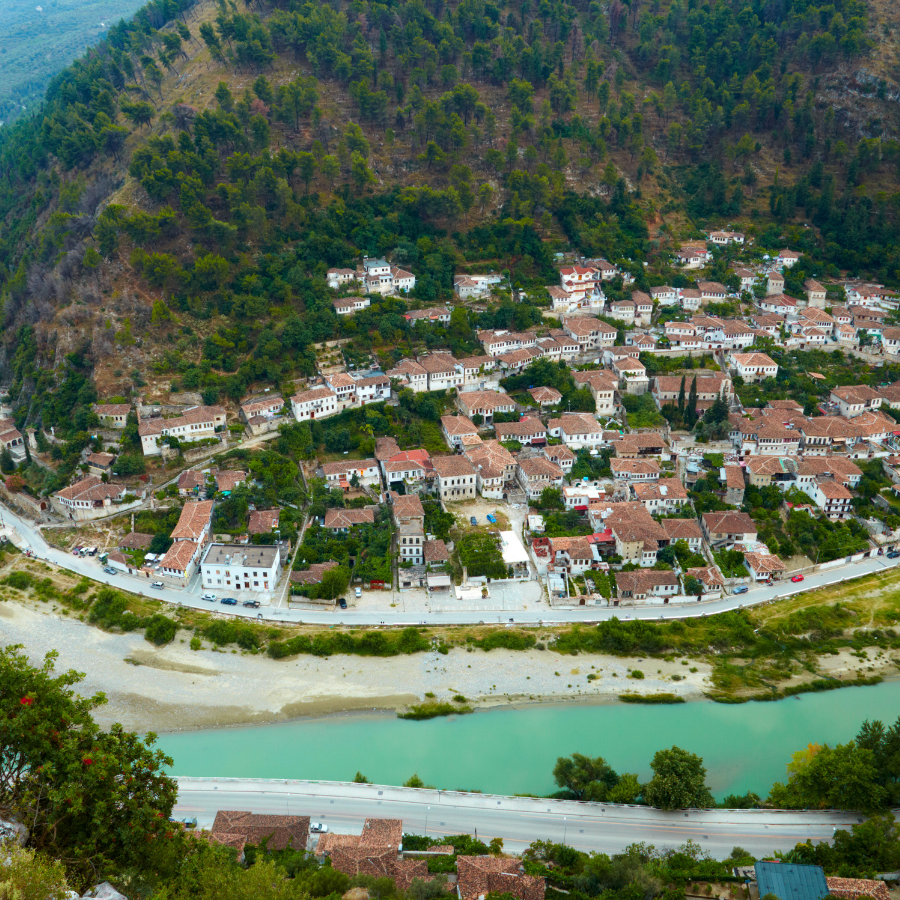
The view from the castle walls looking down over the city is Berat's single best photograph. On a clear day you can see the full sweep of both historic quarters, the silver ribbon of the Osum River between them, and the wide Muzaki plain stretching west toward the Adriatic coast. Bring a wide-angle lens if you have one.
Osum River Canyon — rafting and gorge walks
About 20 kilometres east of Berat, the Osum River cuts through a dramatic limestone gorge up to 120 metres deep and several kilometres long — one of the most spectacular natural landscapes in Albania, and still little-known to international visitors. The best way to experience it is by inflatable raft, drifting through towering canyon walls draped in wild vegetation. Several local operators run guided rafting trips from Berat.
The best season for rafting is March through May, when water levels are high enough for an exciting ride but the weather is mild. By July the river drops significantly and the experience changes. The gorge walk (on foot, along the riverbank) is possible year-round and is spectacular in autumn when the light is lower and the vegetation changes colour.
Berat vs. Gjirokastër — which should you visit?
Where to stay in Berat
Staying within the Mangalem quarter or Kala gives you the full Berat experience. Several converted Ottoman houses now operate as boutique guesthouses, offering rooms with views of the castle or the Osum River. The old town is very compact and entirely walkable, so any accommodation within the UNESCO zone puts you close to everything.
Recommended options include Hotel Mangalemi (a beautifully restored Ottoman house right in the heart of Mangalem), Berat Backpackers (excellent budget option with great social atmosphere), and Guesthouse Lili (simple, family-run, outstanding views). Prices range from about €20 for a hostel dorm to €70–90 for a well-appointed double with breakfast.
Where to eat in Berat
Berat's restaurant scene is concentrated along the Mangalem riverfront promenade and in the lanes of the old quarter. Several establishments are specifically recommended in the Directory Albania listings:
- Taverna Mangalemi — a Berat institution, occupying a terrace in a restored Ottoman building with excellent traditional Albanian food. Try the tavë dheu (clay-pot baked lamb) and the local raki.
- Oborri — popular with both locals and visitors, with a pleasant garden courtyard and a broad menu covering Albanian and regional Balkan dishes.
- Antigoni — great riverside location on the Gorica side, perfect for sunset dinners looking back at the Mangalem hillside.
One strong recommendation: try the local wine. The Berat region — specifically the Korca and Berat plateau — produces some of Albania's best wines, including excellent Shesh i Zi (a local red variety). Ask your waiter for the house local wine and you will rarely be disappointed.
How to get to Berat
Berat is well-connected from Tirana by regular bus service. Buses depart from Tirana's southern bus terminal (Autostacioni Jugor) roughly every hour during daylight hours, and the journey takes approximately 2.5 hours. The fare is around 700 ALL (approximately €6–7). The bus drops you at Berat's new town bus station, from where a short taxi or 20-minute walk takes you to the old town.
By car from Tirana, take the SH3 / A2 motorway south toward Fier and follow signs east to Berat. The drive is approximately 120 kilometres and takes about 2 hours. There is no train service to Berat.
From Gjirokastër, the route passes via Fier and takes approximately 2.5 hours by bus or car — making a combined two-city trip very manageable as part of a southern Albania itinerary.
Practical tips for visiting Berat
- Best time to visit: April–June and September–October. Summer temperatures can exceed 35°C, making the steep castle climb very demanding. Spring and autumn are ideal: mild temperatures, fewer crowds, beautiful light.
- One day vs. overnight: Berat is compact enough to cover the main sights in one long day from Tirana. But spending a night allows you to experience the city at dusk and dawn — when the windows light up and the tour groups are gone — which is a completely different experience.
- The climb to the castle: The path up from Mangalem is steep and partly cobbled. Wear proper shoes and bring water. It takes about 25–30 minutes of uphill walking from the river to the castle gate.
- Photography: The classic view of the thousand windows is best photographed from the Gorica side in mid-afternoon. Sunrise from above (castle walls) is extraordinary. The castle is best lit in the morning.
- Cash: Most restaurants and guesthouses accept cards, but smaller shops and market stalls are cash only. There are several ATMs in the new town.
"I've been to a lot of UNESCO cities across the Balkans. Berat is the only one where I genuinely forgot I was supposed to be sightseeing — I was just living in it for a while, and it was wonderful."
Berat is a city that rewards unhurriedness. Unlike many historic towns that feel like outdoor museums, Berat is still a real, working, lived-in city — children playing on cobblestones, women hanging laundry from Ottoman windows, the smell of coffee and grilling meat drifting up from the promenade. It is one of the most authentically inhabited UNESCO sites in Europe, and one of the very best reasons to visit Albania.
Planning a trip to Berat?
Browse verified hotels, guesthouses, restaurants, and tour operators in Berat.
Browse Berat listings →